The World Economy Is Not Resilient.
It Is Running Out of Runway.
Five forces are simultaneously reshaping the global economic order: a Middle East war, an AI capex reckoning, record sovereign debt, fracturing payment rails, and a stimulus spending race no one can actually afford. Markets are still writing optimism. The data says otherwise.
At the start of 2026, the forecasters were optimistic. Inflation was cooling, AI investment was surging, and the S&P 500 was posting all-time highs. Analysts across Wall Street declared the global economy immune to shock. Then a war broke out, and the picture changed entirely.
The outbreak of the 2026 Iran war and the subsequent closure of the Strait of Hormuz in late February became the defining economic event of the year. More significantly, however, it exposed exactly how precarious the foundations of global growth were all along. The Atlantic Council was right to warn, in January, that markets were “confusing resilience for immunity.” Today, that warning reads like prophecy.
As a result, the IMF’s April 2026 World Economic Outlook now projects global growth slowing to just 3.1 percent this year. That figure is weighed down by the twin pressures of conflict-driven energy disruption and persistent trade fragmentation. For the developing world, moreover, the picture is grimmer still.
The Strait That Changed Everything
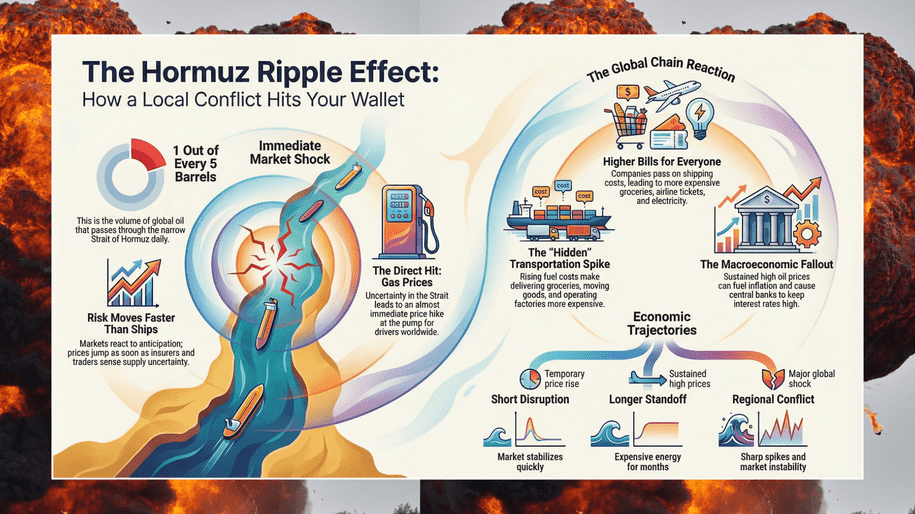
Nothing in 2026 was supposed to look like this. The Strait of Hormuz, through which roughly one-fifth of the world’s oil and a quarter of its liquefied natural gas moves, effectively closed on March 4, 2026, following U.S.-Israeli military strikes on Iran. Consequently, the International Energy Agency called it the largest supply disruption in the history of the global oil market.
Brent crude surged past $100 per barrel on March 8 for the first time in four years, ultimately peaking at $126 per barrel. In parallel, QatarEnergy declared force majeure on all LNG exports. Kuwait, Iraq, Saudi Arabia, and the UAE collectively saw output drop by at least 10 million barrels per day. According to the Dallas Fed, a Q2 closure removes close to 20 percent of global oil supply and could drag annualized global GDP growth down by nearly three percentage points.
The Food Security Dimension
The knock-on effects extend well beyond the pump. Food prices are tracking higher through the fertilizer channel; energy-to-fertilizer cost transmission is not a theoretical risk. It is already visible in commodity markets. The Kiel Institute estimates global food prices could rise up to 2.7 percent under a standard closure scenario, doubling if Saudi export pipelines are also disrupted.
For sub-Saharan Africa, South Asia, and the Middle East, regions with high Hormuz import dependence and limited fiscal buffers, this is not simply a macro data point. It represents a food security crisis in the making. These economies absorbed a shock they had no part in creating.
“The Strait of Hormuz crisis echoes the 1970s energy shock — acute supply shortages, currency volatility, inflationary pressure, and real stagflation risk, all at once.”
— Nexdel Intelligence, Global Economics DeskPaper Prices vs. Physical Reality
A temporary ceasefire announcement in early April briefly calmed futures markets. Brent drifted back toward $97 per barrel. Nevertheless, the physical market told a different story: delivered crude to Asia was still trading at $132 per barrel. That divergence between paper prices and physical reality is itself a signal. Volatility, not resolution, is the new baseline.
The Hormuz crisis has reactivated an energy-inflation feedback loop that central banks spent three years trying to tame. Any scenario in which the strait remains even partially disrupted beyond mid-2026 raises the probability of stagflation in Europe and recession in several emerging economies. Africa’s net oil importers, including Ethiopia, Kenya, Tanzania, and Senegal, are absorbing a shock they had no part in creating.
The AI Capex Question: Who Is Actually Making Money?
The Atlantic Council’s January analysis was correct that AI investment had become a global phenomenon. It also correctly flagged that China’s insulation from a potential U.S. AI bubble deserved attention. What has emerged since, however, is something more nuanced: the AI market itself is fracturing, not collapsing, but differentiating in ways that matter enormously for investors and policymakers alike.
Extraordinary Numbers, Narrowing Margins
The numbers are extraordinary. AI-related investments accounted for approximately 67 percent of U.S. annualized GDP growth in early 2026. Meanwhile, Microsoft’s Azure alone posted a 40 percent growth rate in its latest quarter, with an AI revenue run rate hitting $37 billion, up 123 percent year-over-year. Capital expenditures for a single Microsoft quarter reached $30.88 billion. The capex is real. The question is whether revenue will follow at the same velocity.
At the same time, Meta, Alphabet, and Oracle together face $86 billion in debt issuance obligations for 2026 alone. Unlike the dot-com era, these companies carry profitable cores, but the margin for error is narrowing. When Oracle sold $18 billion in bonds in late 2025, the market’s response was instructive: the stock fell 5.6 percent the following day and has since lost more than a third of its value. In short, investors are distinguishing between companies monetizing AI and companies funding AI on borrowed time.
The AI race has not ended, but the era of undifferentiated enthusiasm is over. Infrastructure providers and those with demonstrated AI monetization are increasingly diverging from speculative AI-adjacent names. For emerging markets hoping to attract AI investment, the window remains open, but only for those with clear data infrastructure strategies, talent pipelines, and regulatory coherence. Nigeria’s Yaba ecosystem, Rwanda’s digital ambitions, and Egypt’s data centre growth are positioned for this moment. Vague policy commitments are not.
The Debt Reckoning: No One Wants to Go First
When central banks step back from bond markets, someone has to step forward. That transfer, from public balance sheets to private investors, is the quiet macro story of 2026. The Bank of Japan and European Central Bank are proceeding with balance sheet unwinding even as the U.S. Federal Reserve pauses. As a result, private investors now need to absorb sovereign debt at scale, and they are demanding higher yields to do it.
Deficits, Yields, and the Confidence Gap
The consequences are not abstract. Higher Treasury yields translate directly into higher mortgage rates, higher corporate borrowing costs, and, critically, higher debt servicing costs for governments already running record deficits. The United States projects a fiscal deficit of at least 5.5 percent of GDP in 2026 while growing at just 2 percent. Furthermore, the EU’s largest economies, Germany, France, Italy, and the United Kingdom, are now expected to contract modestly, according to S&P Global’s May 2026 forecast. Recession, even a shallow one, combined with high debt levels erodes investor confidence quickly.
The Developing World Pays First
For the developing world, the transmission mechanism is more brutal. Tighter U.S. and European financial conditions reduce capital flows to emerging markets, strengthen the dollar, and raise the cost of dollar-denominated debt. UNCTAD projects global growth at just 2.7 percent in 2026, well below the pre-pandemic average of 3.2 percent. The organization notes that many developing economies remain “constrained by heavy debt burdens and limited access to affordable finance.” This is a structural condition, not a temporary headwind.
“When Treasury yields rise, the entire developing world feels the shock — through capital flight, debt servicing costs, and currency depreciation. The G7’s fiscal choices are never just domestic.”
— Nexdel Intelligence, Global Economics DeskThe Payment Architecture War: Wallets, Currencies, and the New Geopolitics of Money
By mid-2026, the Atlantic Council projected that nearly three-quarters of G20 nations would have tokenized cross-border payment systems operational or in active testing. That assessment is tracking. China and India are live. Brazil, Russia, and Australia are building. Meanwhile, the United States, which holds the G20 presidency this year, is attempting to reassert influence over an architecture that has already moved without it.
Energy Payments and Dollar Displacement
This is not merely a technical story about financial infrastructure. It is, instead, a geopolitical contest over whose currency anchors international trade in the next decade. The BRICS cross-border payment platforms are explicitly designed to reduce dependence on dollar-based correspondent banking, covering trade, energy payments, and remittances. Notably, the Hormuz crisis has accelerated exactly the kind of energy payment diversification that these platforms were built to enable. When Gulf exporters need to invoice buyers in alternative currencies due to dollar payment disruptions, the infrastructure to do so is increasingly available.
What This Means for Africa
For Africa, this shift is consequential. Remittance flows, which exceed foreign direct investment as a source of external finance for many African economies, remain trapped in expensive, slow correspondent banking corridors. Pan-African payment systems, including the Pan-African Payment and Settlement System (PAPSS), are positioned to benefit from the same tokenization wave, potentially bypassing dollar conversion entirely for intra-African trade. The question is not whether this architecture will be built. It already is. The question is who will govern it.
The payment architecture war is the most underreported structural story in global economics right now. Its outcome will determine whether the dollar’s reserve currency premium survives the 2030s. African central banks and finance ministries that engage strategically with both the BRICS payment ecosystem and Western-aligned frameworks will have negotiating leverage. Those that wait for a winner to emerge will find the architecture has already been decided for them.
Spending Into the Storm: Stimulus Without Strategy
Germany is ramping defense budgets. Washington is contemplating direct stimulus checks funded by tariff revenues. Japan, similarly, is running its largest peacetime fiscal expansion in a generation. Across the G20, governments are loosening fiscal taps even as debt levels sit at century highs and bond market patience runs thin.
Political Logic vs. Economic Coherence
The rationale differs by country. Some spending, such as Germany’s defense and competitiveness investment, may generate long-term structural returns. However, much of the stimulus calculus appears driven by near-term political logic rather than economic coherence. Running a 5.5 percent fiscal deficit while projecting 2 percent GDP growth is not a recovery strategy. It is, instead, a bet that bond markets will not call the bluff.
The Emerging Market Opportunity — And Its Ceiling
For emerging economies, the picture is more hopeful. The World Bank notes that low-income countries are growing at 5 to 5.7 percent, with stronger domestic demand and, in some cases, genuine fiscal space. The challenge, nevertheless, is that structural headwinds from advanced economy fiscal policy, tighter global financial conditions, and the energy shock will disproportionately constrain this group’s upside. The 1.2 billion young people who will reach working age in emerging markets by 2035 require productive investment in infrastructure, education, and technology, not simply the absence of crisis.
The Bottom Line
The five trends the Atlantic Council mapped in January, covering the AI bubble risk, trade fragmentation, the central bank balance sheet problem, payment architecture rivalry, and reckless fiscal stimulus, have not resolved. Instead, they have compounded. The Hormuz crisis added a sixth variable that none of the January forecasters adequately priced.
The world economy is not in freefall. However, the vocabulary of “resilience” that dominated analyst notes through 2025 is becoming harder to justify. Global growth at 2.7 to 3.1 percent, rising inflation, tightening financial conditions, and a geopolitical shock running through the energy system simultaneously: this is the operating environment for the rest of 2026.
Markets that priced in immunity are now learning the difference. The question, therefore, is whether policymakers in Washington, Brussels, Beijing, and across the developing world can coordinate credible responses before the runway runs out entirely.
“Resilience is not the same as immunity. The global economy is about to learn that distinction at scale.”
— Nexdel IntelligenceFive compounding forces, covering energy shock, AI capex reckoning, sovereign debt overhang, payment architecture fragmentation, and politically-driven stimulus, are operating simultaneously. No single shock is fatal in isolation. Together, they create a feedback environment where one additional variable can tip the system.
For Africa and emerging markets specifically, the exposure is asymmetric: these economies absorb the downside of G7 fiscal choices without access to the policy tools needed to respond. The window for strategic positioning in AI infrastructure, payment systems, and fiscal prudence is open now, not later.
- IMF World Economic Outlook, April 2026: Global Economy in the Shadow of War
- WEF Chief Economists’ Outlook, May 2026
- UNCTAD World Economic Situation and Prospects 2026
- World Bank Global Economic Prospects
- Peterson Institute for International Economics: Global Economy Spring 2026 Prospects
- Dallas Fed: What the Closure of the Strait of Hormuz Means for the Global Economy (March 2026)
- World Bank Commodity Markets Outlook: Strait of Hormuz Disruption (April 2026)
- S&P Global: Global Economic Outlook, May 2026
- Atlantic Council GeoEconomics Center: Five Trends to Watch in the Global Economy in 2026 (January 2026)
- SolAbility: Strait of Hormuz Closure 2026 — Cost Model
- 247 Wall St.: Debt Spirals vs. AI Factories — The Great Macro Divide of 2026 (May 2026)
- Dallas Fed Working Paper: The Impact of the 2026 Iran War on U.S. Inflation (April 2026)
- CNBC: Monetizers vs Manufacturers — How the AI Market Could Splinter in 2026
Analysis and editorial framing by Nexdel Intelligence. All hyperlinks verified as of June 01, 2026.